Your competitors are running ads.
You are not one of them.
Before you spend the first $3,000 learning the hard way, find out whether paid social is viable in your city at all. Meta publishes every active ad in a public library, so who is advertising against you is not a secret, it is a searchable record. Search your own category and city and you will usually find a dozen businesses running ads today, with their offers, their discounts, and their landing pages visible. This $497 plan reads that auction, then gives you a straight go or no-go with the budget it would actually take to compete. If the math says paid social is a bad bet for your margins, you get told that plainly, and the $497 credits 100% toward your launch if it is a go.
Run by the founder, not a junior. Carlos Benavides has managed $50M+ in paid media, so the teardown reads their funnels the way a buyer would, not the way a report template would. Every claim is a screenshot from Meta's own public library.
Named competitors with screenshots or it's free · 48h · credited 100%

What happens when the auction is worked properly
Work our founder, Carlos Benavides, ran before Barlo Digital, in house and at agencies. Screenshots are redacted where a client asked or where an account is live. Barlo Digital is a new firm, so these are his professional history rather than client results the firm is claiming as its own.

Goal was 2.5x. It delivered 9.93x
Warm audiences isolated, ROAS-goal bidding, six hooks tested head to head. The winning creative was scaled the day the data confirmed it.
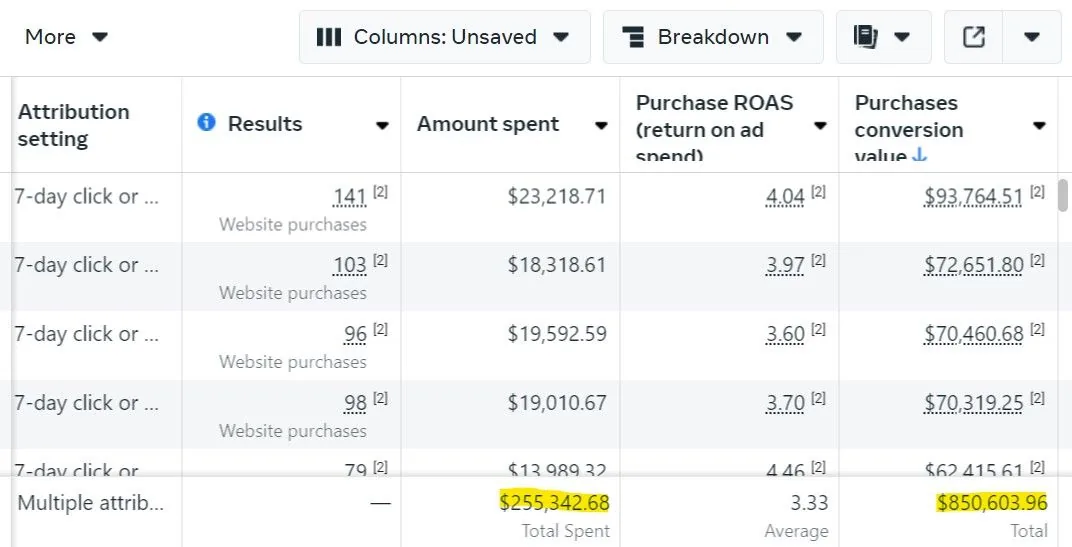
$255K deployed without a ROAS collapse
A 60-day cost-per-acquisition trend found the three campaigns that could actually take budget. Increases applied in steps with guardrails at the ad-set level. The top campaign held 4.67x.
Take the competitor ad checks and run them yourself
Three checks on who is advertising in your market, and what the Ad Library shows versus what it hides. No call, no pitch sequence. One email, and a reply from me if you send your site back.
Pay, tell us your category and service area, and within 48 hours you get a go or no-go verdict on paid social for your market, backed by the list of everyone advertising against you, screenshots of their live ads and offers, what their funnels ask for, and the modelled budget it would take to enter that auction. The competitor teardown is the evidence, not the product. Credited 100% toward the launch build within 60 days. No call required. Checkout is named Competitor Ad Teardown, which is the internal name for this same plan.
Named competitors with screenshots or it's free · 48h · credited 100%What you walk away with
- The actual list of who is advertising against you, by name, in your category and service area, pulled from Meta's public ad library.
- Their live ads, as your customers see them: the hook, the discount, the guarantee, the season they started running it.
- What their funnel asks for: a call, a form, a booking, a quote. This is the part most owners have never looked at, and it is the cheapest competitive intelligence there is.
- A modelled entry cost: what a first campaign would cost to run, what it needs to say to be different rather than louder, and what a realistic first month looks like. Modelled is the operative word. Meta's library publishes creative and activity, never a commercial advertiser's budget or results, so the number you get is built from published cost-per-lead benchmarks for your category, the ad density in your city, and the friction in your own booking path. Anyone who tells you they can read a local competitor's actual spend is guessing.
- A spend-viability check before you commit a dollar. Meta needs roughly 50 conversions a week per ad set to leave its learning phase. Below that the account sits in Learning Limited, where costs stay unstable no matter who manages it. Run against 2025 published cost-per-lead benchmarks, the monthly floor is roughly $8,500 to $12,800 for general dentistry, $15,000 to $25,700 for HVAC, plumbing and roofing, $17,000 to $32,100 for medical spa work, and $32,100 upward for personal injury law. Most local owners are nowhere near those numbers, which is exactly why this check comes before the spend and not after. If yours does not clear the floor, we tell you in the plan rather than take a management fee for an account that mathematically cannot stabilise.
- The alternative if the floor is out of reach, which is the common case: a lean lead-form campaign that buys inquiries without pretending to be an optimized machine, or a different channel entirely. That is a real recommendation, not a downsell.
- An honest verdict on whether to bother. If your category has thin ad competition and strong organic demand, ads may be the wrong next spend, and we will say so.
Check it yourself in two minutes
You do not need us to confirm the problem exists. Meta publishes this for free:
- Open the Meta Ad Library and search your category plus your city, for example "laser hair removal new york" or "roofing contractor dallas".
- Set the filter to active ads only. Now count the distinct businesses.
- Look for your own name in that list. If it is not there, every one of those businesses is reaching customers you are waiting on.
If the list is empty, your category is not competing on paid yet and you do not need this. If it is a dozen names long, that is the teardown.
How the 48 hours work
- Pay the $497 Wise, card, or PayPal. A two-question intake arrives immediately: your category and your service area. Minute one
- We read the auction you are not in Every active advertiser in your category and area, their creative, their offers, and the funnel behind each one. Day one
- You get the verdict and the evidence A go or no-go on paid social, named competitors with screenshots, and the modelled budget to enter. Hand it back to us and the $497 credits 100% toward the build. Within 48 hours
Exactly what's included
- Competitor advertiser list for your category and service area, by name, with screenshots of live ads
- Offer and hook breakdown: what each one promises and how long they have been running it
- Funnel read: what their ads ask a customer to do, and where that customer lands
- Modelled entry cost: first-campaign structure, the budget range published benchmarks say your category needs, and the angle that differentiates rather than imitates
- Go/no-go verdict: whether your numbers clear the learning-phase floor, and what to do instead if they do not
- Launch build available after: campaign and landing page build from $750, management priced separately and month-to-month
$497 plan, credited 100% toward the launch build within 60 days · management is month-to-month, never a contract
How the competitor screenshots may be used. Screenshots are reproduced for analysis, so you can see what your market is being told. They stay the property of the businesses that published them. Copying a competitor's creative, headline, or offer wholesale is trademark and copyright infringement, and Meta's own brand-rights tooling detects visual matches and takes down the copycat account rather than the original. If you ask us to launch a duplicate of a competitor asset during the build, we will decline and propose a differentiated version instead. That is not legal advice, it is the line we work inside.
Before you decide: the full scope and guarantee, and exactly what happens after you pay.
Want the long version first? Full field note: what the Meta Ad Library shows, and what it hides.
Fair questions
I already know I do not run ads. Why pay to be told that?
You are not paying to learn that. You are paying to see what the people taking your customers are actually saying, what they charge, and what they promise, which is the part nobody looks at. That is competitive intelligence you can use whether or not you ever buy an ad from us.
Is this data not free? Why not just look myself?
It is free, and the steps are above, so please do look. What you are paying for is the reading: which offers are working hard enough to keep running for months, which funnels convert and which leak, and what it costs to enter the same auction without simply bidding louder. If you would rather do that yourself, the library is public and we mean it.
What if my competitors are not advertising at all?
Then we tell you that and you keep your money working somewhere better. An empty ad library for your category usually means organic and local search are still cheap in your market, which is a different job. We would rather say so than sell you a campaign into an empty auction.
Can you tell me what my competitors are spending?
No, and neither can anyone else. Meta's public library shows spend, reach, and funding only for ads about social issues, elections, and politics. For an ordinary local business it publishes the creative and the fact the ad is live, nothing financial. Every budget figure in your plan is modelled from published cost-per-lead benchmarks for your category, the ad density in your city, and the friction in your own booking path. If a vendor quotes you a local competitor's real ad spend, they invented it.
I am a dentist, medspa, or law firm. Anything different for me?
Yes, and it matters. Meta's personal-attributes rules mean copy that implies it knows something about a viewer's health, appearance, or legal situation gets rejected, and repeat rejections on a new account compound into a permanent restriction inside the first 30 days. Injectables, weight-loss medication, and telehealth need Meta's written authorisation before they can enter the auction at all, and legal ads sit under your state bar's advertising rules on top of Meta's. Separately, the standard practice of dropping a tracking pixel on a medical or legal site is where the real exposure sits, and we will not do it that way. Your plan says which of these applies to you before you spend anything.
Do I have to commit to management afterwards?
No. The teardown stands alone, and the $497 credits toward a build only if you choose one. Management is month-to-month at full rate with no lock-in, and the build is priced separately so you are never buying a bundle to get the part you wanted.
A limited number of these a week, held so every one lands inside 48 hours. Every week you wait, the businesses in that list keep buying the customers who were deciding between you and them.
Named competitors with screenshots or it's free · 48h · credited 100%